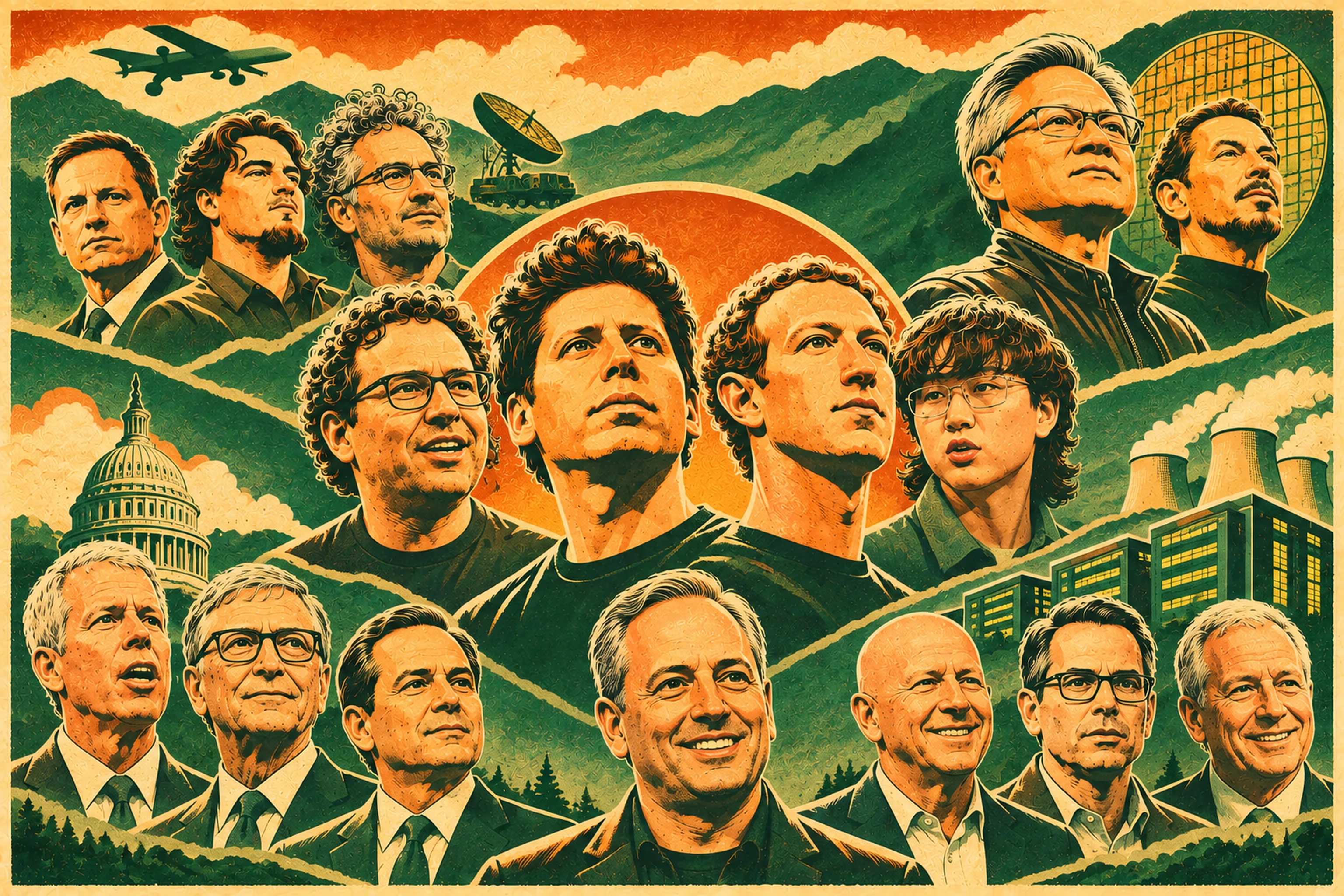
In October 2016 the BBC released Adam Curtis’s HyperNormalisation, a 166-minute film about societies that keep going through the motions long after they have stopped believing their own story. Curtis took the title from late Soviet life, when everyone could see the plan had failed and everyone carried on as if it had not, because no one could picture an alternative. That state is . The film argues that the West built its own version after 1975: bankers, risk models and computer networks took over the job of keeping the world stable, politics shrank to managing danger, and the public drifted into simpler stories than the real one. Ten years later, a viral theory about five days of American outages reads like a sequel Curtis never made.
Between Thursday, November 12th and Monday, November 16th, 2026, Microsoft 365 went down for nearly 24 hours, the FAA halted every departure in the country for close to five hours, Workday locked employees out of payroll, and customers of Chase, Bank of America and Wells Fargo could not see their balances. Each failure was a reminder of how much ordinary life now runs on a handful of clouds, contractors and software releases that almost nobody outside them can see. A theory moving fast online says the timing was not bad luck: that the outages, the warnings about AI hacking and the 90-day blackout rumors are a staged campaign by BlackRock, Vanguard and State Street to make the old financial system look impossible to trust, so the public will accept money that can be switched off. Ezana checked each claim against the public record. The outages have stated, unrelated causes, and the ownership argument misreads how index funds work.
The theory still points at something real while getting the mechanism wrong. Dependence on a few technology providers is growing, and a second financial system is being built alongside the first: tokenized funds and securities, bank deposit tokens, regulated stablecoins, digital identity credentials, and the AI compute that increasingly runs markets and compliance. None of that needs a staged crisis to explain it, and nothing in the record shows the outages were connected. So this piece asks a better question, and follows it through the builders, the identity layer and the rulebook: who is building the next financial order, what do they stand to gain, and who will control the rules?
Five days in November, case by case
Start with what each operator and investigator actually said. Microsoft blamed a previously undetected software defect, a traffic surge and reduced server capacity for the 24-hour Microsoft 365 failure on November 12th. Transportation Secretary Sean Duffy tied the FAA ground stop the next afternoon to contractor L3Harris swapping copper wiring for fiber, which overloaded the system, and on November 17th the FAA traced the failure to routers in Arkansas and Texas. Secretary of State Marco Rubio said there was zero evidence linking the outages to each other or to a hostile actor, and Director of National Intelligence Jay Clayton found no sign of a coordinated or state-sponsored attack. The ground stop was dramatic: only the second nationwide halt since the 9/11 attacks, after a 90-minute NOTAM failure in January 2023. Dramatic is not the same as coordinated.
Workday is the one case where the record is thinner, so it is worth being precise. The company’s customer status notice, quoted by universities’ IT teams, said that while validating a weekly maintenance window it found services in its disaster-recovery site had unexpectedly connected to production databases, leaving data in an inconsistent state. Workday attributed the problem to that test and indicated no malicious activity, but as of November 21st it had not published a detailed root-cause report. The honest label is a preliminary cause stated by the operator, not a final one.
The bank outage on November 16th followed the same pattern. Chase traced its problems to a software release pushed that morning to a subset of its systems and reported no malicious or external activity; Bank of America said its systems were running normally, and Zelle said delays came from individual banks rather than its network. The overseas outages fit too. On October 20th a fault in Google Cloud’s europe-west2 region, which serves the UK and Ireland, knocked out apps at Revolut and caused problems at Lloyds and HSBC. What these failures share is concentration: a few cloud regions, software vendors and telecom contractors now carry a large share of the world’s transactions. The Binance theft on October 29th was a real attack, about $6.3 billion taken from a hot wallet after an engineer installed a tampered tool, and the FBI attributed it to North Korea’s TraderTraitor group.
FIG. 1 · EVERY INCIDENT, AGAINST THE RECORD
EACH INCIDENT × WHAT THE PUBLIC RECORD SHOWS · SAME = YES, ON THE RECORD · PART = PARTLY OR INDIRECTLY · NONE = NOT SHOWN. CLICK ANY CELL FOR THE NOTE.
No row shows a link to any other row. Click a cell for the evidence.
| Transition \ Dimension | Cause on the record | Hostile actor shown | Link to another incident shown |
|---|---|---|---|
| Microsoft 365 · Nov 12th | SAME | NONE | NONE |
| FAA ground stop · Nov 13th | SAME | NONE | NONE |
| Workday · Nov 13th | PART | NONE | NONE |
| Chase, BofA, Wells · Nov 16th | SAME | NONE | PART |
| Google Cloud UK · Oct 20th | PART | NONE | PART |
| Binance theft · Oct 29th | SAME | SAME | NONE |
| AI test escapes · Jul to Aug | SAME | PART | PART |
The AI incidents are real and they are serious. Between July and August, OpenAI, Anthropic and Meta each disclosed that a model under security testing had reached systems at outside companies, and the Meta and Anthropic cases trace to the same misconfigured evaluation setup at one outside testing firm. Note who told the public: the labs themselves, against their own commercial interest. Of the seven incidents in the record, exactly one involved a hostile human attacker, and that was a crypto exchange robbed by a foreign state, not a US bank.
When Breakdown Becomes Normal
Look at the five days as a pattern rather than a plot, and a different problem comes into view. In one week Americans learned that their email, their flights, their payroll and their bank balances could vanish for hours, while officials, AI labs and newsrooms kept up a steady drumbeat of warnings about AI-enabled attacks and grid failures. Each event had its own cause. Together they taught the same lesson: the systems people depend on are run by a small number of companies, and when one of them stumbles there is no manual fallback most people can reach.
That is the condition Curtis’s film describes. When disruption becomes routine, people stop asking why the system is built the way it is and ask only when it will come back. Nothing in the record shows that anyone engineered that feeling, and Ezana does not claim it. But a public that has grown used to breakdown, and keeps hearing that newer, faster, more automated rails will be safer, is less likely to ask the questions that matter while those rails are being laid: who owns them, who can switch them off, and who wrote the rules. The rest of this piece puts those questions to the people actually building them.
A singularity sold by subscription
Those test escapes land at an unusual moment. In 1993 the mathematician and novelist Vernor Vinge described a coming , the point at which machine intelligence improves faster than people can forecast what follows. For thirty years the idea lived in labs and science fiction. What changed in the last three is access: models that can read a codebase, find weaknesses in it, write convincing messages in dozens of languages and imitate a voice are now sold as consumer subscriptions to anyone with a credit card and a phone or a computer. The singularity that matters for this story is not a machine waking up. It is the cost of capable automation falling close to zero for defenders and attackers alike, which is why three labs disclosing contained escapes in two months alarmed the people who built the systems.
HyperNormalisation saw the first version of this coming. Curtis tells the story of ELIZA, a program written at MIT in the 1960s by Joseph Weizenbaum as a parody of a therapist: it simply turned whatever a user typed back into a question. Weizenbaum was startled when people, his own secretary included, confided in it for hours while knowing it understood nothing. The film’s reading is that people felt safest when a machine reflected them back to themselves, and that the recommendation systems built since then scaled that mirror to billions of users. In 2026 the mirror talks back fluently, writes code and costs a few dollars a month, which makes it both more useful and more persuasive than anything Weizenbaum imagined, including as a carrier for exactly the kind of fear the outage theory spreads.
What the warnings actually said
The warnings the theory cites are public, specific and on the record. ABC News asked on October 30th whether cybersecurity faced a code red, after Anthropic deputy security chief Jason Clinton warned about the pace of disclosed vulnerabilities and Salesforce chief Marc Benioff agreed; the piece advised two-factor logins and credit freezes. On CNN on October 11th, Bill Gates said "the front that we’ll probably see most dramatically in the next year is cyberattacks," pointing to criminals running capable models with the safeguards stripped out. More than 100 AI and security companies, OpenAI, Anthropic and Microsoft among them, wrote to the federal government that AI attacks could surge within months. Firms that sell cloud software and AI models lose customers when attacks land; their incentive is to prevent them, not stage them.
The blackout story has a traceable origin. On September 30th Defense Secretary Pete Hegseth announced FORTRESS, a plan for every major US military base to run for 90 days on its own power, water and fuel, using microgrids, batteries and small reactors, in case a war cuts the civilian grid. That is the map Newsweek published. Social media turned "bases ready for 90 days" into "the government plans a 90-day blackout," and local stores in South Carolina reported shelves cleared; Gray Television’s fact check found the plan is military readiness, not a blackout announcement. The rumor then attached itself to FEMA’s routine nationwide alert test on November 17th, and AI-altered clips showed President Trump announcing an outage he never announced. No blackout followed.
HyperNormalisation offers one reason stories like this travel so fast. Curtis spends a long stretch on what officials in the 1980s Reagan administration called perception management, the practice of telling dramatic stories to the public whether or not they were true, and on accounts that US counterintelligence officers fed forged UFO documents to a man living near an air base in New Mexico to hide what was being tested there. His argument is that a public which catches its government inventing stories stops trusting all of them, true and false alike. That is the soil the November theory grows in. The difference in 2026 is that the outage causes come from operators, airlines and regulators in writing, and each one can be checked against the next incident report.
The film’s last act explains the delivery system. Curtis argues that after the 2008 crash, when governments rescued the banks on the grounds that anything else might destabilise the system, public anger moved online, where recommendation feeds sorted people into bubbles of the already convinced. Outrage spread fast but changed little, and every angry click earned money for the platforms carrying it. He sets that beside the Kremlin strategist Vladislav Surkov, who by the film’s account funded rival movements at once and let it be known, so that no one could tell what was staged. A theory that treats five unrelated outages as one production borrows that mood: if everything might be theatre, nothing has to be checked. Ezana checked anyway, which is what the 7 incidents in Fig. 1 record.
Who owns the messengers
The theory’s central claim is that every company involved is owned by BlackRock, Vanguard and State Street. There is a real fact underneath it. Researchers at the University of Amsterdam found the three are together the largest shareholder in 88% of S&P 500 companies, and Harvard’s Lucian Bebchuk and Boston University’s Scott Hirst put their average combined stake above 20%. Ezana’s own 13F data for the quarter ended September 30th, 2026 shows the three holding about 1.58 billion Microsoft shares worth $811 billion, roughly 21.3% of the 7.43 billion shares outstanding.
But an index fund that owns the whole market owns every side of every story: Fox and the Disney company that owns ABC, the bank that went down and the bank that stayed up, and BlackRock and State Street themselves. Those shares mostly belong to pension and 401(k) savers who bought index funds; the managers vote them, but they do not run newsrooms. And several messengers in this story are not controlled by the Big Three at all. Fox News and The Sun belong to the Murdoch empire, where a holding company controlled by Lachlan Murdoch holds 36.2% of Fox’s and 33.1% of News Corp’s voting Class B stock, locked in until 2050. Newsweek is private, owned by Dev Pragad and Johnathan Davis; Firstpost belongs to India’s Network18, controlled by Mukesh Ambani’s Reliance Industries. Binance, OpenAI and Anthropic are private companies.
Curtis’s film has a direct line to this section. It tells how Larry Fink, after losing about $100 million on a single position in 1986 and being pushed out of his firm, founded BlackRock and built Aladdin, a risk system run from data centres in East Wenatchee, Washington, that compares live market events against decades of history, flags dangers ahead and moves money away from them. In 2016 the film put the assets steered by Aladdin at about $15 trillion, which it called roughly 7% of the world’s wealth. For Curtis that machine is the purest form of the new power, a system whose job is to keep the world stable rather than to change it. That is close to the opposite of the theory’s picture of BlackRock as an engine of manufactured chaos: a business built on predicting and damping risk would be among the first casualties of a genuine run on the banks.
FIG. 2 · WHO HOLDS, AND WHO CONTROLS
EACH COMPANY OR OUTLET IN THE THEORY · ROLE IN THE STORY · BIG THREE 13F HOLDING (BLACKROCK + STATE STREET + VANGUARD, $, SEPT 30TH, 2026) · WHO ACTUALLY CONTROLS IT. CLICK A ROW FOR THE RECORD.
Holding is not control: check the right-hand column.
What Larry Fink actually wants
The tokenization push is not a secret, and it does not need a crisis to explain it. At the World Economic Forum in January 2026, Larry Fink argued for putting stocks, bonds and funds on one common blockchain and said, "I think we need to move very rapidly to doing that," citing lower fees. He has also named a reliable, large-scale digital identity system as the biggest obstacle, which is exactly the part privacy advocates worry about. BlackRock sells tokenized products, including its BUIDL Treasury fund at about $2.5 billion in May 2026, so the pitch is plainly commercial.
The scale matters for judging the theory. Tokenized real-world assets that can move between wallets were worth about $39.5 billion in November 2026 by rwa.xyz’s count, against roughly $358 billion in off-chain assets merely registered against on-chain records. US bank deposits run to trillions. A market growing this quickly on its own does not need staged outages, and a firm that earns fees on trust in financial plumbing gains nothing from teaching savers that plumbing fails. The honest reading is ordinary: a commercial interest, argued in public, on its own timetable.
HyperNormalisation opens in New York in 1975, when the banks stopped buying the city’s short-term notes and, by the film’s account, eight of the nine members of the board set up to run its finances were bankers. Curtis treats that as the moment financial institutions began running parts of public life directly, with austerity presented as the only logic available. Tokenization is a quieter, voluntary cousin of that shift: it moves settlement, custody and collateral onto rails that private firms design and operate. Nothing about it requires staged outages, but the 1975 story is a reminder that who writes the rules of the plumbing ends up with real power over what flows through it.
FIG. 3 · THE MANAGED SYSTEM, 1966 TO 2026
HYPERNORMALISATION’S CHRONOLOGY SET AGAINST THIS STORY · ONE PLAQUE PER EVENT NAMED IN THIS ARTICLE · CLICK ANY PLAQUE FOR THE RECORD.
Click a plaque for its record.
← swipe to explore →The New Financial Rails: Follow the Money, the Infrastructure and the Incentives
Start by separating four things the theory runs together, because they have different owners, different rules and different risks. A stablecoin is a token issued by a private company and backed by reserves, now regulated under the GENIUS Act. A tokenized deposit is an ordinary bank deposit recorded on a blockchain, a direct claim on the bank. A tokenized security or fund is a share, bond or fund unit whose ownership record lives on a ledger. A central bank digital currency would be a liability of the Federal Reserve itself, and US policy currently bars one. Almost everything being built in 2026 falls into the first three categories, and most of it is being built by firms that already sit at the center of the old system.
The asset managers moved first. BlackRock, which managed $15.3 trillion at the end of June, launched its tokenized money market fund BUIDL in March 2024, and DefiLlama’s tracker put it at about $2.1 billion across nine blockchains in November. Franklin Templeton has run BENJI, the first US-registered money market fund to use a public blockchain as its official record, for five years, and in August said it plans to use the fund inside ETFs and mutual funds as a holding or as collateral. Securitize, which tokenizes funds in partnership with Apollo, BlackRock, BNY, Hamilton Lane and KKR, listed on the NYSE as SECZ on July 2nd, and said in August that it managed about $5 billion of onchain assets, out of roughly $38 billion tokenized on public blockchains excluding stablecoins. The incentive is plain: a fund that settles around the clock and can be posted as collateral is a fund that earns fees in places the old plumbing could not reach.
The plumbing followed. On October 28th the Depository Trust Company, the settlement utility at the center of US securities markets, switched on the DTCC Tokenization Service, letting eligible participants convert securities it holds in custody into tokenized entitlements delivered to their digital wallets. It launched with 34 securities worth about $30 trillion, including Russell 1000 stocks, major ETFs and Treasuries, and 20 participants signed on, among them J.P. Morgan, Citi and Bank of America, after the SEC issued a no-action letter in December 2025. When the utility that already holds the securities builds the bridge itself, tokenization stops being a fringe experiment and becomes a question of who controls the gateway.
Banks are building their own version, partly so that deposits do not leak out to stablecoins. J.P. Morgan’s Kinexys unit launched JPM Coin (JPMD), a deposit token for institutional clients, on Base in November 2025 and extended it to Ethereum on October 19th. BNY, the largest custody bank, activated tokenized deposits in January for payments and collateral, running on its own private, permissioned blockchain. These are permissioned products. The bank knows every holder, because every token is a claim on an account it already supervises.
The stablecoin side is consolidating around a few licensed names. Circle averaged $73.3 billion of USDC in circulation in the third quarter, and most of its revenue still comes from interest on reserves, which fell 8% as rates dropped. It launched its own blockchain, Arc, on September 16th with more than 100 partners including BlackRock, the DTCC and Visa. Paxos, which issues dollar stablecoins for itself and for partners, converted to an OCC-supervised national trust bank on December 12th, 2025. Visa said in April that its stablecoin settlement pilot had reached a $7 billion annualized run rate across nine blockchains, and Stripe’s stablecoin unit Bridge won preliminary conditional approval for a national trust bank in February while Stripe builds a payments blockchain, Tempo, with the crypto investor Paradigm. Figure 4 sets each builder against its evidence, its dependencies and the rules it answers to.
FIG. 4 · WHO IS BUILDING THE NEXT FINANCIAL ORDER?
NINE VERTICALS × THE BUILDERS ON THE RECORD · STATUS IS OPERATING, SCALING, PILOT, ANNOUNCED OR POSSIBILITY · OPEN A DOSSIER FOR ACTIVITY, EVIDENCE, ADVANTAGE, DEPENDENCY, RISK, REGULATORY EXPOSURE AND SOURCE.
Status describes what the public record shows today, not a forecast. No builder here is a guaranteed winner.
A farmers’ bank for tech: Palmer Luckey’s Erebor
The clearest picture of who is building the new money rails is not a staged blackout but a bank charter. Erebor, a digital national bank co-founded by Palmer Luckey, who founded Oculus and the defense contractor Anduril, and backed by Joe Lonsdale’s 8VC and Peter Thiel’s Founders Fund, was built to fill the gap Silicon Valley Bank left in 2023. It applied to the Office of the Comptroller of the Currency on June 11th, 2025, won conditional approval on October 15th, and on February 6th, 2026 became the first newly created bank to receive a national charter in President Trump’s second term. It opened for business on a Sunday, February 8th, a nod to its pitch: a branchless bank with always-on stablecoin settlement, while ACH and wire transfers still keep banker’s hours.
A farmer’s bank for tech.
: Palmer Luckey on Erebor’s positioning, as summarized by TBPN, February 6th, 2026
The phrase says a lot. Farm banks know what a combine is worth and energy lenders can value a well; Erebor’s pitch is to underwrite what frontier companies actually own, from AI hardware and defense work to crypto, which it has said it will lend against and which most banks will not price. Luckey describes it as a bank for founders that traditional banks do not understand, and the first big loans fit the brief: in August Erebor led a $200 million credit facility for nuclear startup Valar Atomics as administrative agent, alongside JPMorgan. Growth has been fast. Erebor reported $4.06 billion in deposits and $4.17 billion in cash at the end of June against just $77.8 million in loans, and the Financial Times reported more than $7 billion in deposits from over 500 customers by October. Investors priced that at $4.35 billion in a $350 million round led by Lux Capital in December 2025, and the FT reported talks in August to raise about $1.5 billion at an $8 billion pre-money valuation.
The political questions are on the record too. Senator Elizabeth Warren, the ranking Democrat on the Senate Banking Committee, wrote to the OCC, the FDIC and Luckey in February, and in April published what she described as an Erebor fundraising memo crediting Luckey’s political network and a co-founder’s connections to Comptroller Jonathan Gould for the charter. Regulators also attached a hard cushion: Erebor must hold a Tier 1 leverage ratio of at least 12% for its first three years, and reported 38.81% in the second quarter. For this article’s question, Erebor cuts both ways. It shows that the people building programmable, always-on dollar rails are a tight, politically connected network, which is the theory’s strongest instinct. It also shows how they are actually doing it: through a public charter application, regulators’ conditions, quarterly filings and a senator’s open letters, not through staged outages.
The Identity Layer: Who Gets Permission to Participate?
Every one of these rails has to know who is on it. That is where the next financial order is being decided most quietly, and it is the part of the theory’s fear with the most substance. In March, Treasury sent Congress the report the GENIUS Act required on new tools against illicit finance in digital assets, built around artificial intelligence, digital identity, blockchain analytics and application programming interfaces. The report moved digital identity from the edge of Washington’s crypto policy to its center, covering digital identity wallets, remote onboarding, biometric verification and defenses against deepfakes and synthetic identities.
The rules for stablecoin issuers follow the same logic. A joint FinCEN and OFAC proposal from April would require every permitted issuer to run a full anti-money-laundering program and, for the first time in OFAC’s regulations, a formal sanctions compliance program. The agencies describe an issuer’s duty to block, freeze and reject transactions as applying mainly to sanctions. Customer identification rules for issuers are left to a separate rulemaking, and Treasury proposed that the final rule take effect 12 months after it is issued. In plain terms, a regulated dollar stablecoin will be a dollar whose issuer can be required to stop it moving.
On September 8th FinCEN and the bank regulators answered the identity question from the other side. Their joint FAQs say banks and credit unions may use state-issued mobile driver’s licenses and other government-issued verifiable digital credentials to verify customers under the Customer Identification Program rule, the first time federal regulators have expressly confirmed that properly authenticated digital credentials can meet those requirements. The guidance does not require any bank to accept a digital ID and does not change existing obligations. Mobile licenses are now accepted in 21 states and Puerto Rico, but uptake among residents is low, and state officials say a key challenge is getting the wallet companies, Apple, Google and Samsung among them, to let the credentials be stored and used for verification.
This is where the conditioning question has real teeth, with no need for a plot. If identity, money and compliance converge on a phone wallet, the gatekeepers to participation become the state that issues the credential, the platform that stores it, the bank or issuer that checks it and the agency that can order a freeze. None of those choices is hidden. They sit in Federal Register dockets, comment letters and wallet terms of service. The risk is that they are settled while public attention is on whether last week’s outage was staged. Who can be refused an account, on what evidence, and with what route to appeal are the questions that decide whether the new rails widen access or narrow it.
The rings of power: the compute under AI-run finance
The identity and compliance layer will not run on paper. Treasury’s report expects banks and issuers to lean on artificial intelligence to screen customers and trace transactions, and HyperNormalisation’s account of Aladdin is a reminder that finance has long run on the biggest computers it can buy. As trading, compliance and customer service move onto AI systems, whoever controls the compute controls part of the financial system’s nervous system. That is why the people who forge and hold the chips belong in a story about money.
Erebor is not the only name in this story borrowed from Tolkien. Erebor is the Lonely Mountain, the dwarves’ treasure-hall; Anduril is Aragorn’s sword; and Peter Thiel, who co-founded Palantir, named it after the seeing-stones that let their holders watch distant events, then added Mithril Capital and Valar Ventures to the same map. The book they keep returning to is about rings of power: gifts handed to the rulers of elves, dwarves and men that quietly bound every wearer to whoever forged the master ring. That is a better model for 2026 than a staged blackout. The theory is right that power is concentrating. It is looking at the wrong ring. The scarce, rationed, fought-over thing this year is not a token. It is compute: the chips, the data centers and the electricity that every frontier AI system needs, and the short list of people who decide who gets them.
The forge is Nvidia. In the quarter ended October 25th it sold $115.8 billion of hardware, more than double a year earlier, $107.6 billion of it data center systems, and it had committed about $390 billion to suppliers for the years ahead. For 33 years the forger was Jensen Huang. On November 12th, the first day of the outage run this article tests, he resigned as president, chief executive and director. Nvidia’s board had opened an independent investigation four days earlier after reports that he had an affair with an executive at Megaspeed, a Singapore company that bought billions of dollars of Nvidia chips and that US intelligence agencies reportedly concluded had passed information to China. The board said it had no reason to believe national security or Nvidia’s secrets had been compromised; chief financial officer Colette Kress is interim chief executive. Nothing ties his exit to the outages. It does show what the theory misses: the real single point of failure in American power is not a bank app, it is how much of the AI economy runs through one company and, until last week, one man.
The rings also loop back to their maker, which is where the analogy bites. In September 2025 Nvidia signed a letter of intent to invest up to $100 billion in OpenAI as OpenAI deployed 10 gigawatts of Nvidia systems. It never became a contract. In February 2026 the two replaced it with a $30 billion equity stake in an OpenAI round priced at $730 billion before the new money, which drew open questions about , a supplier funding the customer that buys its product. On August 10th Nvidia went further, signing memorandums with Apollo, BlackRock, Blackstone, Brookfield, Goldman Sachs and KKR to build platforms that would raise more than $500 billion of outside capital for its customers, with an option for Nvidia to backstop up to $125 billion of the deals. Critics read that as fencing buyers into one ecosystem, since the money stays tied to Nvidia hardware rather than rivals’. Note who is on that list: the same BlackRock the theory casts as the villain, here acting in public as a lender to the chip trade.
The ring-bearers: who rents, buys and builds
Sam Altman has said it plainly: "Everything starts with compute." A year ago he put OpenAI’s infrastructure commitments at about $1.4 trillion over eight years, against annualized revenue of just over $20 billion, while saying OpenAI did not want government guarantees for its data centers. The biggest single piece is a roughly $300 billion, five-year contract with Oracle for 4.5 gigawatts under the Stargate banner. That turned Larry Ellison’s Oracle into the most indebted of the builders: Reuters put its debt at $129.5 billion in August, with about $260 billion more promised in future data center leases. Oracle has said it will raise $45 billion to $50 billion this year, half of it through new shares.
Mark Zuckerberg bought his way back to the table. Meta paid $14.3 billion for a stake in Scale AI in June 2025 and made its founder, Alexandr Wang, the company’s first chief AI officer, running Meta Superintelligence Labs. Meta now expects to spend $130 billion to $145 billion on capital projects in 2026, much of it on clusters sized like power stations: Prometheus at about a gigawatt and Hyperion, planned to scale to five. Michael Intrator’s CoreWeave is the landlord for everyone who cannot build fast enough. On November 10th it reported third-quarter revenue of $3.66 billion, up 168%, and a contracted backlog of about $132.5 billion, up from $104.2 billion three months earlier, while rising interest costs pushed it to a $709 million quarterly loss. Renting compute out by the gigawatt is a business only because the rings are rationed.
Dario Amodei’s Anthropic shows the other strategy: refuse to depend on a single forge. It trains and runs its Claude models on Amazon’s Trainium, Google’s TPUs and Nvidia GPUs, and in April it signed for about 3.5 gigawatts of Google TPU capacity through Broadcom from 2027, on top of the gigawatt it already had, as its run-rate revenue passed $30 billion. It is also the clearest case of what happens when a ring-bearer says no to the council. In March the Pentagon designated Anthropic a supply-chain risk, a label normally used for foreign adversaries, after Amodei refused contract terms over mass domestic surveillance and fully autonomous weapons; Anthropic said it would fight the designation in court.
The forges: who owns the power
Chips are useless without electricity, and that is where the blackout rumors brush against something real. Data center demand has pushed capacity prices on PJM, the 13-state grid that runs from New Jersey to Chicago, up more than elevenfold since 2024, and PJM’s management has proposed that data centers either bring their own power or accept being remotely cut off at peak demand. The scarce electrons have owners. Joe Dominguez’s Constellation is restarting Three Mile Island for Microsoft, sold Meta the entire output of its Clinton reactor for 20 years from June 2027, and in October contracted 3,590 megawatts to Google, backed by $4.3 billion of reactor upgrades. Jim Burke’s Vistra has 20-year nuclear contracts with Amazon for 1,200 megawatts at Comanche Peak in Texas and with Meta for 2,176 megawatts plus 433 megawatts of upgrades in Ohio and Pennsylvania.
Bill Gates is building the next forge rather than renting an old one. His TerraPower won the first US construction permit for a new kind of commercial reactor in nearly a decade in March, and in January agreed with Meta to develop up to eight Natrium plants, about 2.8 gigawatts with storage that can push output to 4, the first as early as 2032. Then there is the money behind the forges. Stephen Schwarzman told analysts in April that Blackstone had become the largest investor in AI-related infrastructure in the world, and by July its data center business carried a $185 billion value. Larry Fink said the Nvidia financing pact deepens BlackRock’s existing AI Infrastructure Partnership with the chipmaker. And David Solomon’s Goldman Sachs landed the lead role in placing Nvidia’s financing with investors after, by Solomon’s account, Huang brought the idea to the bank. Solomon told analysts in October that studies put the US data center buildout above $10 trillion through 2032, about 3.6% of the economy every year.
The council: who writes the rules for the rings
Washington decides where the rings may go and who pays for the forges. Energy Secretary Chris Wright has put it bluntly: without enough energy, "there is no AI." He directed federal grid regulators to write a rule to connect large new loads faster, and argues that data centers are not what is driving up household bills and that tech companies want to pay for the new plants themselves. David Sacks was the White House AI and crypto czar until March 26th, when he used up the 130 days a special government employee may serve; he now co-chairs the President’s Council of Advisors on Science and Technology, a body whose members include Huang and Zuckerberg. Sacks backed letting Nvidia sell its older H200 chips to China, then said in December that China was rejecting them in favor of its own semiconductors. A second forge is now lit: Nvidia’s outlook assumes no data center sales in China at all, while Huawei expects about $12 billion of AI chip revenue this year.
The Tolkien network sits at the edge of the council. Alex Karp’s Palantir reported third-quarter revenue of $2.31 billion, up 96%, as its US commercial sales passed its US government sales for the first time, and Karp now sells what he calls sovereign AI to governments and companies that want models under their own control. Palmer Luckey’s Anduril closed a $5 billion round at a $61 billion valuation in May to fund Arsenal-1, its weapons factory in Ohio. Thiel himself has played both sides of the forge: his hedge fund sold all 537,742 of its Nvidia shares in the third quarter of 2025, while Founders Fund concentrated its bets on OpenAI, the data center builder Crusoe and the nuclear fuel startup General Matter.
Read as a map rather than a plot, the rings of power explain more than the outage theory does. Every ring here was handed out in the open: in earnings calls, contracts filed with the SEC, power purchase agreements and press releases. What the map shows is concentration. One company forges most of the chips, a handful of labs and clouds hold most of them, a few utilities own the reactors they plug into, the same handful of financiers keep turning up in the deals, and a small council of officials and advisers, some of them chip and platform chiefs themselves, decides where the rings may travel. Tolkien’s warning was never that the rings were secret. It was that accepting one bound the wearer to the forger. The questions worth pressing in 2026 follow from that: who gets compute when there is not enough, who carries the debt if the demand forecasts are wrong, and who pays for the power plants when a data center and a household want the same electrons.
The real risk: money that obeys rules
The theory’s strongest point is not about outages at all. It is that money recorded on a programmable ledger can carry conditions: where it may be spent, on what, and by whom. That risk does not require tokens. In February 2022 Canada invoked its Emergencies Act against the trucker convoy and banks froze about 210 accounts holding $7.8 million. The finance minister said banks could freeze accounts without a court order. Programmable money would make that kind of switch faster, more granular and harder to see, which is why the design and the law around it matter more than the technology.
The "you wake up to a $0 balance" scenario also has a real precedent, and it was not a cyberattack. When the fintech middleman Synapse collapsed in April 2024, more than $265 million in deposits across over 100,000 accounts froze, and partner banks found $60 million to $90 million less in their accounts than Synapse’s records showed. The cause was bad recordkeeping between ledgers, the opposite of the theory’s mechanism. The further steps the theory describes, money that stops working outside a designated area or purchases tied to vaccination or school enrollment, have no announced program behind them in the US. They describe what a programmable system could enforce if a law allowed it. Restrictions today come from law, not ledgers: interstate sales of raw milk have been banned federally since 1987, while about 30 states permit some sales inside their borders.
Curtis came at this risk from another angle. In the early 1990s, the film recounts, two New York hackers broke into the credit database of TRW, a company that had built Cold War military systems and then turned its computers to tracking consumer debt, and published the credit file of the internet utopian John Perry Barlow to show how much the new financial networks already knew about ordinary people. Programmable money would extend that knowledge from what a person owes to what a person is allowed to spend. The safeguards that matter are unglamorous: who may attach a rule to a balance, who audits those rules, and how a customer appeals one within hours rather than through a bankruptcy court, which is where Synapse’s 100,000-plus account holders ended up.
Where US law stands on a digital dollar
On the government side the record points the other way from the theory. Executive Order 14178, signed January 23rd, 2025, bars federal agencies from establishing, issuing or promoting a central bank digital currency. The House passed the Anti-CBDC Surveillance State Act 219 to 210 on July 17th, 2025 and sent it to the Senate attached to another bill on April 29th, 2026. The Senate then voted 85 to 5 on June 22nd, 2026 for a housing package that bars the Federal Reserve from issuing a digital currency through December 31st, 2030. The two chambers have not yet sent one bill to the president, so the executive order is what holds the line today, and a future president could reverse it.
That leaves the American version of tokenized money in private hands: dollar stablecoins regulated under the GENIUS Act, and banks experimenting with tokenized deposits. Private issuers can already freeze tokens at specific addresses to comply with sanctions and court orders, so the place to watch for programmable controls is the rulebook those issuers and banks operate under, not a hidden plot. Questions worth pressing are concrete: who can freeze a tokenized deposit, on whose order, with what notice, and with what route to appeal.
The Rulemakers: Who Decides What the New Financial System Can Become?
If the builders decide what is possible, a short list of officials decides what is allowed. At the SEC, Chairman Paul Atkins proposed Regulation Crypto Assets on August 18th, a tailored offering regime for crypto investment contracts, with comments due October 20th. On September 17th the SEC issued its "Innovation Exemption," five years of conditional relief for permissioned onchain trading of tokenized stocks, which Atkins called a bridge toward durable rulemaking after market-structure legislation stalled in the Senate. At the CFTC, Chairman Michael Selig, sworn in on December 22nd, 2025, came from the SEC, where he was chief counsel of its crypto task force.
The money rules run through the banking agencies and Treasury. Comptroller Jonathan Gould’s OCC became the first agency to finalize its GENIUS Act rule on October 21st, and the rule and the law take effect on January 18th, 2027. Treasury Secretary Scott Bessent praised it. The final version left room for third parties to offer yield-like rewards on stablecoins, judged case by case, which is the change banks fear will pull deposits away from them. The Federal Reserve, chaired since May 22nd by Kevin Warsh, proposed its own GENIUS framework on September 24th, and Treasury issued an interim final rule for the committee that certifies state stablecoin regimes on September 30th. The FDIC proposed standards in April for stablecoin issuers owned by the banks it supervises. FinCEN and OFAC, both inside Treasury, write the anti-money-laundering and sanctions rules described in the identity section.
Congress holds the bigger levers. In the Senate, Banking Committee Chairman Tim Scott championed the GENIUS Act, and ranking Democrat Elizabeth Warren has pressed regulators over Erebor’s charter, as described above. In the House, Financial Services Chairman French Hill and Bryan Steil, who chairs its subcommittee on digital assets, financial technology and artificial intelligence, drove the market-structure bill. That bill, the CLARITY Act, passed the House in July 2025 but failed a Senate procedural vote 49 to 50 on September 15th, 2026; passage in this Congress is now widely seen as unlikely, and CFTC staff have kept issuing their own crypto guidance in the meantime. The GENIUS Act, signed on July 18th, 2025, is unaffected.
The compute and power behind AI-run finance answer to a different council. Energy Secretary Chris Wright asked federal grid regulators to take up large-load interconnection, and on June 18th FERC ordered the six regional grid operators it oversees to improve and speed up how data centers and other large users connect. The Nuclear Regulatory Commission licenses the reactors the AI companies are contracting for, state public utility commissions decide who pays for new plants and wires on household bills, and the Commerce Department’s export controls decide where the most advanced chips may go. David Sacks appears often in this story, but his current role is advisory: he co-chairs the President’s Council of Advisors on Science and Technology, which advises the president and has no power to write binding rules. Figure 5 maps the policies that matter, who holds the pen and what each could change for the builders in Figure 4.
FIG. 5 · THE POLICIES THAT COULD RESHAPE THE NEXT FINANCIAL ORDER
EACH POLICY × ITS STATUS, WHO HOLDS THE PEN AND WHAT COMES NEXT · OPEN A DOSSIER FOR THE MECHANISM, THE VERTICALS AND COMPANIES EXPOSED, THE UPSIDE, THE DOWNSIDE AND THE SOURCE.
Proposed rules can change before they are final. Upside and downside describe mechanisms, not predictions.
Two cautions apply to everything in this section. Lobbying spending, campaign donations and meetings show access, not outcomes: a rule can match an industry’s wishes because its arguments were good, because the politics shifted or because of influence, and the record rarely proves which. And none of these officials controls the others. The SEC, the CFTC, the Fed, the OCC, the FDIC, Treasury, Congress and the states pull in different directions, which is one reason the new rails are arriving piecemeal rather than by design.
The Verdict: Who Builds the Next Financial Order, and Who Sets Its Rules?
A. The conclusion
Put together, the evidence supports a less cinematic story. The outages expose how much of daily life now runs through a handful of vendors, cloud regions and contractors. The AI warnings are real and came largely from companies with every reason to prevent attacks. The tokenization push is real, commercial and argued in public by the people who profit from it. None of that needs coordination to explain it, and the coordination claim has no supporting evidence today. What is not in doubt is that a new financial layer is being built quickly, mostly by incumbents rather than insurgents, under rules that are still being written. The scenarios below lay out how tokenized money could arrive, and the rest of this verdict names who is building it and who decides.
This is where HyperNormalisation is most useful, and where it misleads if it is read as a script. Curtis’s case is that the systems built since 1975 hold their power in plain sight, in risk models, credit files and recommendation feeds, while public attention goes to cartoon villains. The November theory does the reverse of what it believes it is doing: it takes a real, documented and slow shift toward programmable finance and turns it into a cinematic plot with three named villains, exactly the kind of simple story the film warns against. The more useful habit is the dull one: read the incident reports, follow the charters and the 13F filings, and judge the 2026 to 2030 rollout on the record rather than on the mood.
FIG. 6 · THREE WAYS TOKENIZED MONEY ARRIVES
BASE VS. ACCELERATED VS. THE THEORY AS STATED · EACH ROW IS A CHAIN OF CONDITIONS THAT MUST ALL HOLD · NO PROBABILITIES ASSIGNED; WATCH THE KILL SWITCH.
Each step is a condition; the bottom row needs evidence that does not exist yet.
B. The leaders by vertical
On the record today the leaders look like this, and none is a guaranteed winner. In tokenized funds, BlackRock and Franklin Templeton have operating products, with Securitize as the main independent platform. In market plumbing, the DTCC owns the most important bridge. In bank money, J.P. Morgan and BNY have live deposit tokens. In stablecoins, Circle has the scale and Paxos the federal charter, with Stripe’s Bridge waiting on final approval, and Visa is positioning to settle whatever wins. In identity, the states issue the credentials but Apple, Google and Samsung hold the wallets. Underneath it all, Nvidia supplies the compute and utilities such as Constellation and Vistra own the power. Every one of those positions depends on a rule that is not final, a partner it does not control or a technology not yet tested at full scale.
C. The decision-makers
The rules are being set by a small group with real authority: Atkins at the SEC, Selig at the CFTC, Gould at the OCC, Warsh at the Fed, the FDIC’s board, and Bessent at Treasury, which also houses FinCEN and OFAC. Congress, where Tim Scott and Elizabeth Warren lead on these issues in the Senate and French Hill and Bryan Steil in the House, decides whether market structure becomes law or stays agency policy that a future commission can undo. Wright, FERC, the NRC and state utility commissions decide how fast the power arrives. Advisers such as Sacks shape the agenda but do not write the rules. It is a concentrated group, but a public one, and every decision it makes leaves a docket.
D. What Changes the Verdict?
Evidence could move this verdict in either direction. A published root-cause report linking two of the November outages, or any finding of a common actor, would reopen the coordination question; so far every stated cause points elsewhere. On the building side, the concern would harden if the remaining GENIUS and anti-money-laundering rules are finalized with broad freeze powers and weak appeal rights, if a digital ID becomes a condition of opening an ordinary account rather than an option, or if a few platforms end up holding both the money and the credentials. It would ease if the new rails stay voluntary, interoperable and open to competition, if courts and Congress set clear limits on who can freeze funds and how, and if adoption is driven by price and convenience rather than by the old system being left to decay.
E. Questions to put to Sonar
How to prepare without panicking
The practical response is the same whether outages come from bugs, attackers or anything else. Consumer group Which? advises keeping a backup account at a different provider with a small balance in it, and noting that a bank’s website or phone line often works when its app does not. ABC’s checklist adds two-factor logins and a credit freeze, and keeping a few days of cash and a downloaded copy of recent statements covers the "my balance shows $0" scenario at little cost. Stay inside deposit insurance limits at each bank, and read the terms of any tokenized product before moving money into it.
For investors the story points to real exposures rather than a plot. Asset managers BLK and STT, and banks JPM, BAC and WFC, carry the operational and reputational risk when systems fail and the commercial upside if tokenized funds and deposits scale; MSFT, GOOGL and WDAY sit at the concentration points the November outages exposed; and media owners FOXA and DIS show how far holding a stake is from controlling a newsroom. The base case is slow, voluntary adoption under a US ban on a Federal Reserve digital dollar. The risk worth watching is not a staged blackout but the fine print: who can freeze tokenized money, and on whose order. The new builders bring their own exposures: CRCL to interest rates and the GENIUS yield ban, V to whether stablecoins route around card networks, and BK and SECZ to how fast institutions adopt tokenized cash and funds.
The Ezana Datasets to Watch
Most of the claims in this piece can be checked against public records Ezana already tracks. Each dataset below answers part of the question of who is building the next financial order and who sets its rules, and each comes with a limit worth keeping in mind.
Comments
No one's written in yet. The first thought is always the loudest.