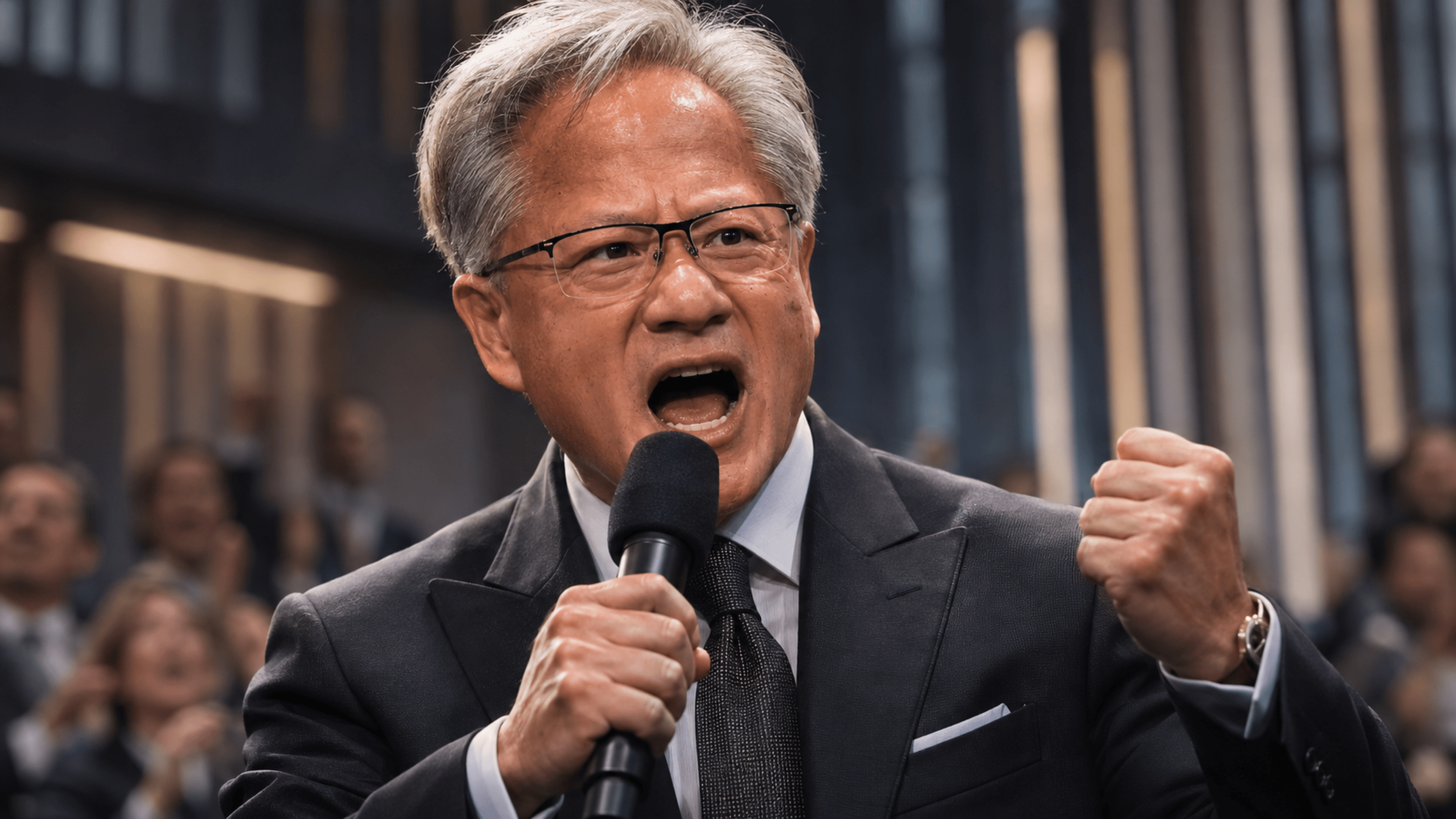
Nvidia’s board reinstated Jensen Huang as president, chief executive and director on Monday, November 23rd, eleven days after announcing his resignation, in a unanimous vote taken after a series of meetings in which directors said they were satisfied with his candor and ability to lead. The stock opened at $167.04, up 33.1% from Friday’s close, and added roughly $1 trillion in market value within minutes. The reversal is real, but partial. Nvidia remains about 30% below its October 6th record, and the reinstatement settles none of the outside inquiries that drove the board to accept his exit in the first place.
Eleven days, one round trip
The slide began before the scandal. Nvidia was the world’s most valuable company as recently as November 3rd, then fell 7.4% on November 5th alone with the rest of the chip sector after the Democrats’ midterm victory and weak guidance from Qualcomm. On Sunday, November 8th, Huang admitted in a message to employees that he had been unfaithful to his wife, after The New York Times reported his relationship with Alice Huang, a former executive of the Singapore data center company Megaspeed whom US officials suspect of working for Chinese intelligence. Shares fell 4.3% on Monday, erasing about $192 billion, and another 5.47% on Tuesday.
The board initially said it had confidence in Huang. By Thursday, November 12th, after a second Times report that he had also had a relationship with an executive who reported to him, he was gone, with chief financial officer Colette Kress named interim CEO and director Harvey Jones named the company’s first-ever chair. The worst came the following week. Nvidia lost 23% between November 16th and 20th, its worst week since 2008, including a 14% fall on Friday alone, and closed at $125.53, nearly 48% below its record. On the day of the resignation, Nvidia’s value fell below $4 trillion for the first time since 2025, and by Friday it ranked fourth among the world’s companies by market value, down from first.
FIG. 1 · THE ROUND TRIP
NVDA SHARE PRICE, USD, OCTOBER 6TH TO NOVEMBER 23RD, 2026 · DAILY CLOSES, EVERY SESSION FROM NOVEMBER 5TH · HOVER A DATE FOR THE PRICE
Monday’s open recovered the scandal’s losses, not the October high.
CNBC reported that Monday’s jump recovered nearly all of the roughly 33% the stock had lost since the November 8th admission, and that the falling share price helped accelerate the board’s talks with Huang, which began on Saturday and concluded at a second meeting on Sunday. The October high is a different matter. From the open, the stock still needs a 43% gain to regain $239.24, the record close.
How a founder discount compounds
What the market priced between November 8th and 20th was a on a company with no clear successor. Bloomberg noted in January that Huang, then 62 and the longest-serving CEO in Silicon Valley, had no obvious heir after 33 years running the company he co-founded in 1993. Each revelation widened the discount, and the resignation turned a reputational problem into an operating one: in a single week, the company that supplies most of the world’s AI compute had an interim CEO who was also its CFO, a chair 11 days into the role and a headhunter looking for a replacement. The six phases below are the loop the stock moved through in 15 days; the reinstatement only damps it if the investigations end without a finding that restarts it.
FIG. 2 · THE KEY-PERSON LOOP
SCHEMATIC OF THE SIX PHASES NVIDIA MOVED THROUGH, NOVEMBER 8TH TO 23RD, 2026 · AMPLITUDE GROWS TO THE VALUE COLLAPSE, THEN DAMPS ON REINSTATEMENT
A negative investigative finding would restart the loop at phase 1.
← swipe to explore →What the board actually decided
The November 23rd filing is short on conditions. It lists no formal terms for Huang’s return beyond the board’s satisfaction with his candor, and it says directors received input from senior levels of the US government before concluding that his reinstatement poses no national security risk. Jones remains chair, a role created only 11 days earlier, and Kress returns to finance full time. The filing also confirms that the special committee formed to examine whether Huang was the target of a foreign intelligence effort will keep working, so the board has reinstated its CEO before the investigation into him has reported. Jones has sat on the board since its founding in 1993 and owns about 0.03% of the company.
I did not live up to the standards expected of everyone at Nvidia.
: Jensen Huang, statement, November 17th, 2026
The board’s turn was fast. On November 17th, opening Nvidia’s third-quarter call, Jones said the board had unanimously accepted the resignation and did not intend to reinstate Huang, and that Heidrick & Struggles had been hired to find a permanent CEO. Pressure built over the next six days: a petition with more than 175,000 signatures, backing from Elon Musk and Epic Games’ Tim Sweeney, and President Trump saying on November 16th that he would not mind a return. Trump had been involved from the start: The New York Times reported that he called Huang on Tuesday, November 10th, two days before the resignation, and urged him to keep fighting for his job, and on Sunday, November 22nd, he publicly called on the board to bring him back. Some large shareholders pushed the same way: Altimeter’s Brad Gerstner and Atreides’ Gavin Baker wrote to the board asking it to keep all options open, including Huang’s return. The board instead added structure: a National Security and Export Control Committee of independent directors, and a search for Nvidia’s first chief compliance officer, who will report to the governance committee.
Seven outside inquiries the vote does not close
The reinstatement ends the leadership vacuum, not the legal exposure. By one count, 8 investigations and legal threats were active going into the weekend, and none of them reports to the board that voted on Monday. Ezana’s list below has the board’s own special committee plus seven outside bodies: the Justice and Commerce departments’ criminal probe of Megaspeed, a reported SEC civil probe, California’s attorney general, six congressional committees counted as one row, a shareholder class action, Singapore police and the Treasury. Only the first is under Nvidia’s control, and the filing says it will proceed to a conclusion with Huang’s cooperation. Nvidia also says it will keep cooperating with government investigations and inquiries, the only reference in the filing to the other 7.
FIG. 3 · WHO IS STILL LOOKING
OPEN INVESTIGATIONS, INQUIRIES AND PRESSURE POINTS AS OF NOVEMBER 23RD, 2026 · BODY · WHAT IT EXAMINES · STATUS · KEY RISK · CLICK DOSSIER FOR THE RECORD
One of eight is the board’s own; none has reported findings.
The Treasury row is the political tell. Scott Bessent called for a dramatic shake-up and an outside CEO on November 15th; a day later the president he serves said he would not mind Huang’s return. The board sided with the second view and said the government gave input, but Bessent’s 10-day request for answers runs to about November 25th. The Megaspeed case is older than the scandal. Jensen Huang was seen with Alice Huang at Computex in Taipei in 2024, after Megaspeed had agreed to a multibillion-dollar purchase of Nvidia hardware, and US officials say they later worked with Singapore on an on-site check in which she, then CEO, was interviewed.
What Huang’s return means for CUDA and custom chips
The scandal hit Nvidia just as its grip on new AI compute was loosening. In a November 14th note, JPMorgan’s Michael Cembalest counted the compute agreements frontier AI labs have announced for deployment from 2026 onward: about 43.9 gigawatts in total, of which Nvidia holds 12.1 gigawatts, or 28%, against the 80% to 90% of AI chip revenue it took in 2024 and 2025. Broadcom-designed custom chips hold 23%, AMD 18%, Amazon’s Trainium 16% and Google’s TPU 14%. Taken together, the custom accelerators account for 23 gigawatts, about 52% and nearly twice Nvidia’s share. An earlier version of the same chart, cited in coverage around November 15th, had Nvidia at 39%.
FIG. 4 · WHO WON THE NEXT 44 GIGAWATTS
ANNOUNCED FRONTIER-LAB COMPUTE AGREEMENTS FOR DEPLOYMENT IN 2026 AND LATER, BY CHIP SUPPLIER, GIGAWATTS · HOVER A SLICE FOR ITS BREAKDOWN
Custom accelerators together now outweigh Nvidia nearly two to one.
- Nvidia GPUs12.1 GW
- Custom accelerators23 GW
- AMD GPUs8 GW
- Cerebras0.8 GW
CUDA, Nvidia’s software platform, is the part of the moat a change of CEO touches most directly, because it rests on developer habit rather than contracts. Cembalest relays a frontier lab’s account that porting a model to AMD GPUs used to take six to 12 months and now takes about three days, which is how AMD reached 18% of the new agreements. Huang’s answer has been to make CUDA the best place to start rather than the only place to run. On the Dwarkesh Podcast in early October he called CUDA a rich ecosystem that is the smart first target for any new computer, and said Nvidia contributes heavily to the back end of Triton, the open compiler labs use to write their own GPU kernels.
The resignation tested that strategy in public. On November 12th, TF International’s Ming-Chi Kuo argued that Nvidia’s succession uncertainty gave Google’s TPUs and their partners Broadcom and MediaTek an opening to win more trust from customers and the supply chain. The market traded it that day: Broadcom closed 5.5% higher and AMD 5.9% higher while Nvidia fell 4.3%. Kuo’s deeper point was about suppliers. He credited Huang with the capacity pre-booking and spec upgrades behind Nvidia’s yearly product cadence, called those commitments among the core reasons its supply chain trades at high multiples, and expected a restructuring to dent competitiveness in 2028 at the earliest.
The reinstatement removes that 2028 risk, but not the economics pulling the hyperscalers toward their own silicon. Under Huang, Nvidia acted as supplier, lead investor, anchor customer and lease guarantor across more than 200 startups, deals that ran on his personal relationships, while custom ASICs already make up 28% of AI server shipments and 15% to 20% of accelerator revenue. Those programs answer to their owners’ budgets, not to Nvidia’s org chart: Broadcom has guided to $115 billion of AI semiconductor revenue in fiscal 2027, double fiscal 2026. They also run on their own cycles. Broadcom fell 12.2% on November 20th after Kuo reported that Google had cut its 2027 order for Broadcom-designed TPU 8i chips, a reminder that custom-chip demand can wobble for reasons that have nothing to do with Huang.
Monday’s rally, ticker by ticker
The move spread well beyond Nvidia because Nvidia sits inside so much of the market. It is held by 1,068 US-listed ETFs, nearly 20% of the domestic ETF universe, and ranks among the top 15 holdings in 628 of them. By late morning Nebius and CoreWeave, both dependent on Nvidia supply, were up as much as 35% and 31% from Friday’s close, while AMD and Broadcom had gained at most 12.5% and 6.6%. The Nasdaq Composite gained about 1,650 points, or 7%, in the minutes after the announcement, and Nvidia reclaimed the No. 2 spot by market value that it had lost the week before.
FIG. 5 · WHO MOVED WITH HUANG
GAIN FROM THE NOVEMBER 20TH CLOSE TO MONDAY’S INTRADAY HIGH, %, AS OF LATE MORNING ON NOVEMBER 23RD, 2026 · CLICK DOSSIER FOR THE PRICES
Nvidia’s dependants moved most; the custom-chip side moved least.
The ranking reads like a dependency map. The neoclouds, which buy almost all their compute from Nvidia, moved nearly one for one with it, and Taiwan Semiconductor and Micron, which make and feed its chips, rose about 21%. The custom-chip side moved least: Alphabet and Broadcom, the TPU’s owner and designer, gained 7.3% and 6.6% at their highs, after Broadcom and AMD had been the main winners on the day Huang resigned. Investors treated his exit as a share shift toward Nvidia’s rivals and unwound part of that trade on his return. CNN also noted that US stocks were already poised for a sharp bounce on Monday after the previous week’s punishing tech sell-off, so not all of the move belongs to Huang.
Verdict: a third of the damage repaired
Measured against the full drawdown, Monday was a partial repair. Nvidia was worth $5.77 trillion at its October peak and $3.03 trillion at Friday’s close, a loss of $2.74 trillion; the roughly $1 trillion recovered at the open is about 36% of it. The rest belongs to things the vote did not change: the post-midterm chip sell-off, the shift in Nvidia’s China outlook to zero data center compute revenue, and the open inquiries in Fig. 3. Shares were still down about 30% for the year even after Monday’s jump, a reminder that the drawdown began before November 8th and will not end on governance news alone.
FIG. 6 · HOW MUCH CAME BACK
NVIDIA MARKET VALUE LOST FROM THE OCTOBER PEAK ($5.77T) TO THE NOVEMBER 20TH CLOSE ($3.03T), $ TRILLION · SPLIT BY WHAT MONDAY’S OPEN RECOVERED
About a third recovered; about two thirds still missing.
- Recovered on reinstatement36%1T
- Still below the October peak64%1.74T
The base case is that the special committee closes without a finding against Huang and that his return holds Nvidia’s position with the frontier labs rather than restoring it: CUDA stays the default first target while the custom programs keep growing on their own budgets. On that path the October record is reachable, but it needs a 43% gain from Monday’s $167.04 open. The kill switch is measurable on two fronts. If Nvidia closes below $125.53, Friday’s trough, the market will be pricing the investigations above the founder; and if Nvidia’s share of announced frontier-lab compute for 2026 and later is still below a third, against 28% on JPMorgan’s count, when that tally is next updated, the founder premium is buying continuity, not market share.
For investors, the eleven days set a price on Huang that no proxy statement ever had to: about $1 trillion of value moved on his status alone in a single session. Nvidia (NVDA) now carries a founder premium again, alongside a legal overhang that the reinstatement leaves fully in place. CoreWeave (CRWV) and Nebius (NBIS) remain the most leveraged expressions of that premium, Taiwan Semiconductor (TSM) and Micron (MU) the suppliers that win whoever designs the chip, and Broadcom (AVGO) and Alphabet (GOOGL) the custom-silicon side whose case does not depend on who runs Nvidia. AMD (AMD) holds the share most exposed to a stronger Nvidia. The dates to watch are about November 25th for Bessent’s deadline, the special committee’s findings, and late February 2027 for the first results under the restored CEO.
Comments
No one's written in yet. The first thought is always the loudest.