A slide has been making the rounds in pitch decks and investor newsletters this fall. It draws the AI industry as a five-layer pyramid, Application, LLMs, "Cloud," Chips, Power, and attaches a rough dollar figure to each: ~$1T, ~$5T, ~$10T, ~$10T, ~$2T. Read top to bottom, it tells a comfortable story: value is spread across the stack, every layer is a multi-trillion-dollar opportunity, and the picks-and-shovels trade and the application trade are both alive.
We checked. Three of the five numbers don't survive contact with a quote screen.
This is a findings piece, not advice. We are re-weighing a diagram, not recommending a position.
FIG. 1 · THE SLIDE VS THE QUOTE SCREEN
EACH LAYER OF THE AI STACK, $ TRILLION · THE FIGURE ON THE CIRCULATING SLIDE VS THE VALUE VERIFIED AGAINST MARKET CAPS AND LAST PRIMARY ROUNDS · CLICK A ROW FOR WHAT WAS COUNTED
Cloud and silicon are whole-company market caps, not AI revenue.
How we re-weighed it
Public companies get their market cap as of October 12 to 13, 2026, from companiesmarketcap, stockanalysis and Yahoo Finance. Private companies get their last primary round, the post-money valuation at which new shares were actually sold, not a secondary print or a reported IPO target. Where a company plausibly sits in two layers (Alphabet is a cloud, a model lab and a chip designer), we assign it once, to the layer where most of its enterprise value lives, and say so.
That method is conservative on purpose. Anyone can inflate a layer by counting Microsoft three times.
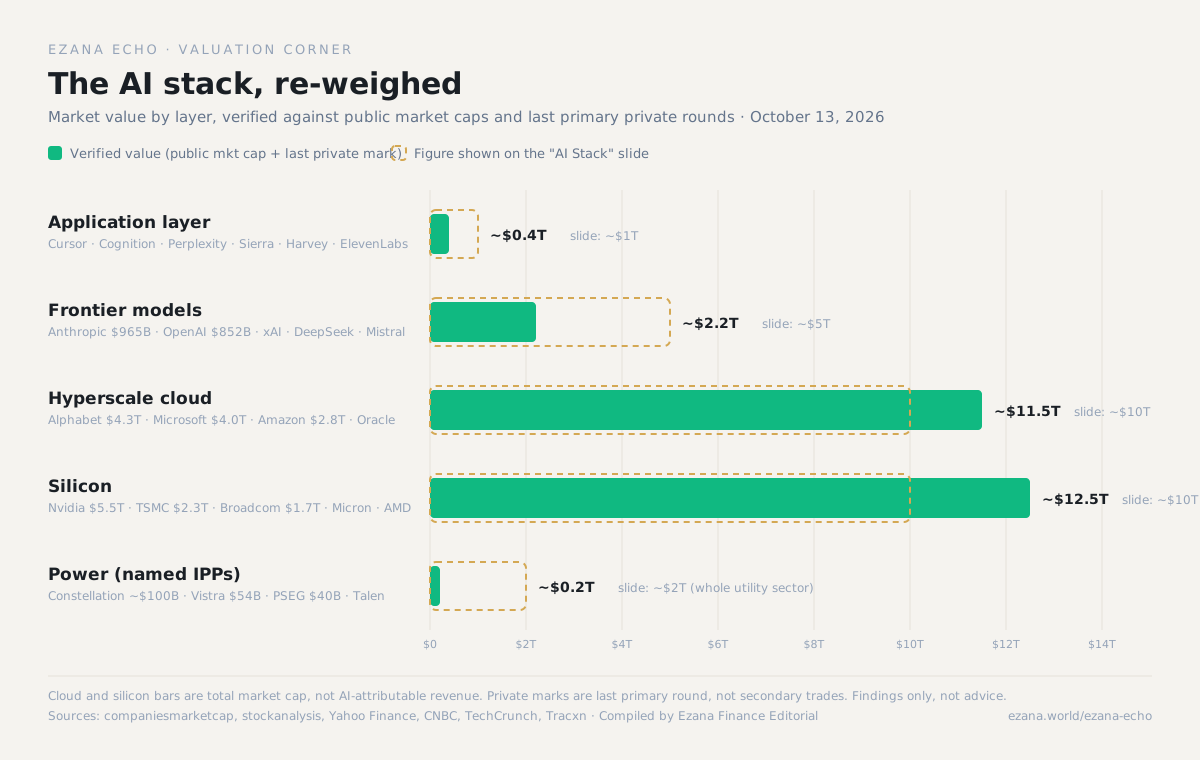
Silicon: ~$12.5 trillion, not ~$10T
The bottom of the pyramid is heavier than the slide admits. Nvidia alone is about $5.5 trillion, having flirted with $6 trillion the week of October 6 after announcing the largest buyback in corporate history. TSMC is roughly $2.3 trillion ahead of its October 15 earnings. Broadcom sits near $1.7 trillion, Micron around $1.2 trillion and AMD just above $1 trillion. Add ASML, SK Hynix, Samsung's semiconductor business, Marvell and Intel and the layer clears $12 trillion comfortably.
FIG. 2 · THE TWO BLOCKS AT THE BOTTOM
SILICON AND HYPERSCALE CLOUD BY MARKET CAP, $ TRILLION · LEAF AREA IS MARKET CAP · FILL IS YEAR-TO-DATE DIRECTION WHERE THE TEXT GIVES ONE (ORACLE, DOWN ABOUT 30%); THE REST ARE LEFT NEUTRAL
Area only for most leaves: the piece reports caps, not returns.
← swipe to explore →One caveat the slide skips: these are whole-company caps. TSMC fabs iPhone chips; Micron sells consumer DRAM. But for the three largest names, the market is pricing AI data-center demand as the dominant driver, and that is the number investors are actually trading.
Hyperscale cloud: ~$11.5 trillion, but "cloud" is doing a lot of work
Alphabet ($4.27T), Microsoft ($4.0T), Amazon ($2.83T) and Oracle ($0.43T) total about $11.5 trillion. Count Meta ($1.85T) as a hyperscaler, it builds data centers at the same scale, and you are near $13.4 trillion.
So the slide's ~$10T is defensible. The label is not. Most of Alphabet's value is search advertising. Most of Amazon's is retail and logistics. Azure crossed $100 billion in annual revenue this year, which is enormous, but Microsoft is a $280 billion-revenue company. Calling this layer "cloud" quietly attributes trillions of ad, retail and Office revenue to AI infrastructure. Oracle, the purest AI-infrastructure bet of the four, is the smallest and is down roughly 30% year to date on exactly that concentration.
Frontier models: ~$2.2 trillion, not ~$5T
This is where the slide starts to drift. On last primary marks: Anthropic $965 billion (Series H, May 2026), OpenAI $852 billion (March 2026), xAI roughly $250 billion before it folded into SpaceX, and a long tail, DeepSeek, Mistral, Thinking Machines, Safe Superintelligence, that together adds perhaps $150 billion. Call it $2.2 trillion.
FIG. 3 · PRINTS VS INTENTIONS
FRONTIER LABS · THE LAST PRIMARY ROUND AGAINST THE LISTING OR TALKS REPORTED SINCE · CLICK DOSSIER + FOR THE RECORD
Only the primary round is a price; the rest are reports of intent.
You can get to $5 trillion, but only by counting things that have not happened or that already live in another layer. Anthropic is reported to be targeting an October Nasdaq listing at up to $2 trillion; OpenAI is reported to be in talks around $1.4 trillion. Those are intentions, not prints. Google DeepMind and Meta's model labs are real frontier efforts, but their value is already inside the cloud layer above. Count them again here and the pyramid double-counts.
The honest read: the model layer is worth less than half the chip layer, and the gap between the top two labs and everyone else is wider than the gap between the labs and the hyperscalers.
Application layer: ~$0.3 to 0.5 trillion, not ~$1T
The slide's headline example is Harvey, which raised $550 million at $15.5 billion in September on revenue that crossed $400 million in ARR. It is the best-known vertical AI company in the world, and it is 0.3% of Nvidia.
Stack up every application-layer name with a public mark, Cursor ($60B, acquired by SpaceX in June), Cognition ($48B), Perplexity (~$30B), Scale AI (~$29B), Sierra ($15.8B), Harvey ($15.5B), ElevenLabs ($11B), Legora ($5.6B), Glean, Decagon, OpenEvidence, Lovable, and you reach $300 to 400 billion. Be generous with the unlisted tail and you might touch $500 billion. A trillion requires counting Palantir, Salesforce and ServiceNow as "AI applications," which stretches the word past usefulness.
FIG. 4 · THE APPLICATION LAYER, NAME BY NAME
APPLICATION-LAYER COMPANIES WITH A PUBLIC MARK, $ BILLION · LAST PRIMARY ROUND OR ACQUISITION PRICE · THE EIGHT NAMED WITH A FIGURE IN THE TEXT
Together these eight are about $215 billion; the layer as a whole is $300 to 400 billion.
← swipe to explore →That is not a knock on the layer. Cursor went from $1 million to $2 billion in ARR in about three years, the fastest B2B ramp on record. ElevenLabs reportedly passed $500 million ARR. The application layer is where revenue multiples are most defensible; Harvey at roughly 40x ARR looks cheap next to some labs. It is simply much smaller than the slide implies, and most of it is private.
Power: ~$0.2 trillion for the companies on the slide
The slide lists four logos, Constellation, Vistra, PSEG, Talen, next to "~$2T mkt cap." Those four companies are worth about $200 billion combined: Constellation roughly $95 to 105 billion, Vistra $54 billion, PSEG around $40 billion, Talen $15 billion. All four are off their 2025 highs; Vistra is down about 17% over the past year as PJM regulatory friction and battery-storage setbacks eroded the "AI premium."
FIG. 5 · FOUR LOGOS, $200 BILLION
THE INDEPENDENT POWER PRODUCERS NAMED ON THE SLIDE, MARKET CAP $ BILLION · CONSTELLATION AT THE MIDPOINT OF ITS $95 TO 105 BILLION RANGE
The slide's $2 trillion is the whole US utility and independent-power sector.
← swipe to explore →The $2 trillion figure only holds if you mean the entire US utility and independent-power sector, most of which has nothing to do with data centers. The AI-power trade, as the market actually prices it, is a $200 billion trade.
The shape that emerges
Lay the verified numbers out and the pyramid flips. The slide shows a stack that narrows gracefully toward the top. The market shows two enormous blocks at the bottom, silicon and hyperscale cloud, roughly $24 trillion together, and then a cliff. Models are a tenth of that. Applications are a fiftieth. The power layer the slide draws as a $2 trillion foundation is, for the named companies, smaller than the application layer.
FIG. 6 · THE PYRAMID, FLIPPED
VERIFIED VALUE BY LAYER, $ TRILLION · EACH BAR SWEEPS WITH ITS LAYER'S TOTAL · SEGMENTS ARE THE NAMED COMPANIES WITH A FIGURE IN THE TEXT, PLUS THE REMAINDER
Silicon and cloud together are about $24 trillion; models, applications and power about $2.8 trillion.
Three observations follow, none of them a trade.
Value is pooling where capital intensity is highest. The two layers that require tens of billions in annual capex are worth ten times the three layers that don't. That is the opposite of what software investors spent twenty years learning.
Private marks are doing the heavy lifting at the top. Nearly every dollar in the model and application layers is a VC post-money, not a public price. The first real test comes if Anthropic prices its listing this month; the gap between a $965 billion primary and a $2 trillion IPO is itself a $1 trillion opinion.
"Cloud" is the most mislabeled box on the slide. It is the only layer where the verified number is roughly right and the interpretation is roughly wrong. Investors who buy hyperscalers as an AI-infrastructure play are mostly buying advertising and e-commerce with an AI option attached.
The slide is not dishonest. It is a sketch, and sketches round. But rounding $0.4 trillion up to $1 trillion and $2.2 trillion up to $5 trillion is not rounding; it is a thesis. The thesis is that value will flow up the stack. The quote screen, for now, says it hasn't.
Comments
No one's written in yet. The first thought is always the loudest.